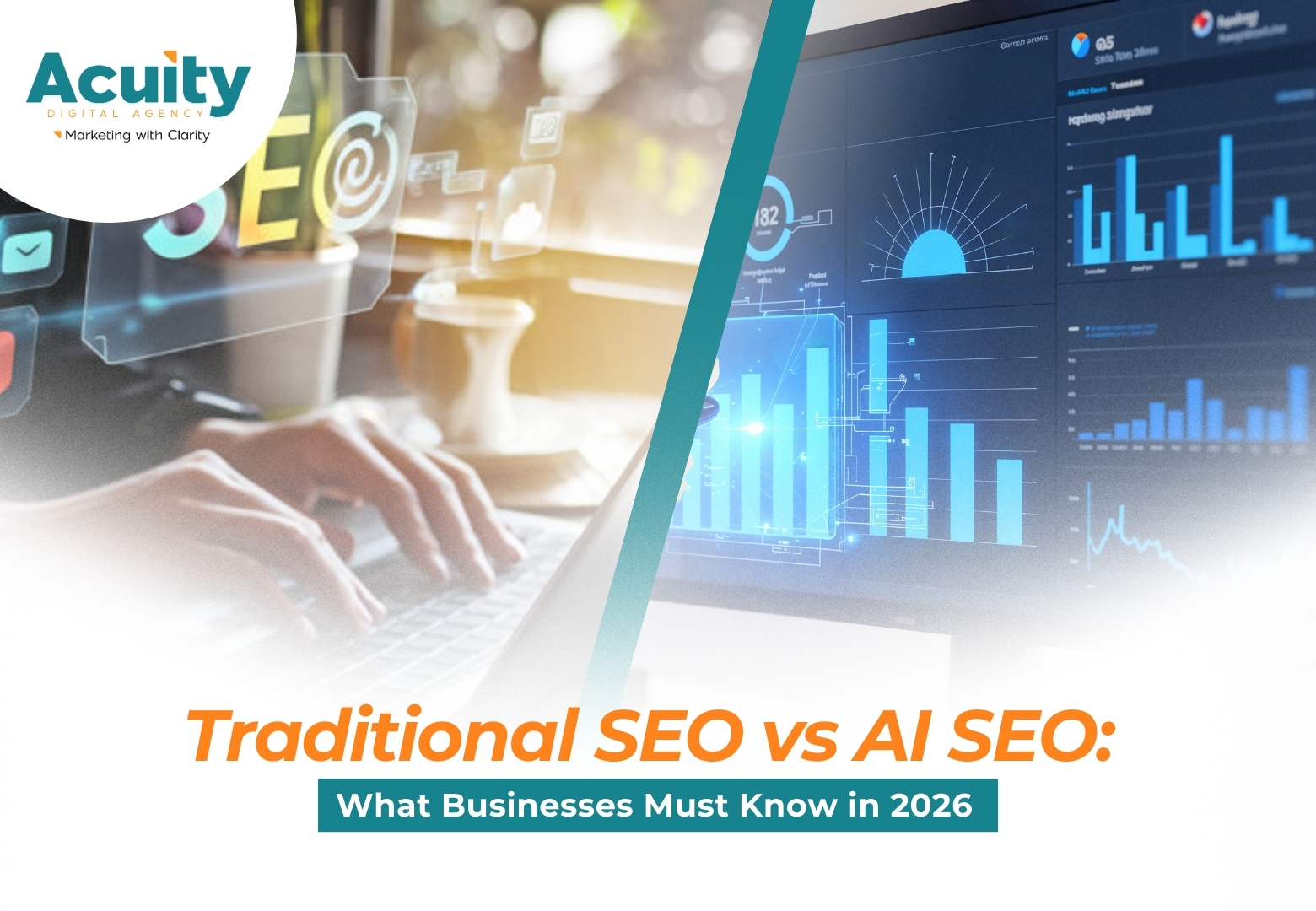
AI tools are changing how people search for information. Keep reading to learn how traditional SEO differs from AI SEO, why you need both, and simple steps to stay visible in 2026’s competitive market.
The Search Revolution
Before AI, ranking on Google’s first page was the ultimate goal. Now it’s changing quickly.
Today, people get answers from ChatGPT, Google’s AI Overviews, and Perplexity without clicking a single link. Your website might rank well, but if AI tools don’t mention your brand, you’re missing a huge amount of potential customers.
Does traditional SEO still work in 2026? Yes, but it’s only half the puzzle now. Understanding AI SEO vs traditional SEO isn’t optional. It’s essential for survival.
Let me show you exactly what’s different and how to adapt.
What is Traditional SEO
Traditional SEO is what most businesses have done for years. It focuses on making your website visible in search engine results pages (SERPs).
The core elements included:
- Keyword research and targeting
- Creating quality content
- Building backlinks from other websites
- Optimizing page titles and meta descriptions
- Improving website speed and mobile experience
- Fixing technical issues
These elements help search engines understand your content and rank it higher. When someone searches on Google, you want your page to show up at the top.
So you still need to know basic SEO. Here’s a detailed blog on this: Why Local SEO Still Matters in the Age of AI.
Now, AI tools are answering questions directly without sending users to your site, which is why you need to understand AI SEO.
Understanding AI SEO Basics
AI SEO basics start with a different question. Instead of asking “how do I rank?” you ask “how do I get cited(mentioned)?”
AI SEO means optimizing your content so AI tools can understand it, trust it, and reference it in their responses.
Think about it this way. When someone asks ChatGPT or Google’s AI a question, these tools scan content across the web. They look for clear, accurate, well-structured information. Then they summarize it into an answer.
If your content is confusing, poorly organized, or lacks authority, AI tools will skip it. Even if you rank well in traditional search.
Here’s what makes AI SEO different:
- Focus on conversational language and natural questions
- Structure content for easy extraction
- Build topical authority across related subjects
- Earn brand mentions even without backlinks
- Provide direct answers at the start of sections
It completely transforms how AI changes SEO for small businesses and big brands alike. But you still need both of them.
Why You Need Both Strategies
Some people say traditional SEO is dead. That’s not true.
Others completely ignore AI SEO. Big mistake.
The best AI SEO strategy uses both methods.
Traditional SEO creates your base. It makes sure search engines can find and index your pages. It builds technical strength and trust.
Without strong traditional SEO, you won’t show up in search. Your site will be slow, difficult to crawl, and skipped by both users and AI.
AI SEO grows your visibility. It gets your brand mentioned in AI answers. It positions you as a reliable source that AI can cite.
Without AI SEO, you miss the traffic that stays inside AI tools. You disappear from AI summaries, chatbots, and voice search.
When you use both strategies, you get full coverage. You appear in traditional search results AND in AI-generated answers.
Practical Steps To Optimize For AI
Want to know how to optimize content for AI overviews? Start with these proven tactics.
Answer questions directly. Put clear, short answers at the start of each section. Don’t hide important information in the middle.
Use natural language. Write the way people actually talk and ask questions. Conversational content works better in AI responses.
Structure content logically. Use clear headings that show what’s coming next. Break big topics into easy sections.
Build topical authority. Cover subjects completely across multiple articles. Link related content together to show your expertise.
Add supporting evidence. Include data, examples, and expert quotes. AI tools prefer well-researched, factual content.
Use schema markup. Help AI understand what type of content you have, like articles, products, recipes, or FAQs.
Earn brand mentions. Get featured in trusted publications, directories, and review sites. Even mentions without links help AI trust you.
These steps work because they match how AI reads information. Clear structure, natural language, and trust signals make your content worth citing.
Final Thoughts
The AI SEO vs traditional SEO debate misses the point. You need both to succeed in 2026.
Traditional SEO builds your foundation. AI SEO expands your reach by making content citation-worthy.
Search is changing fast. Your strategy should too.
At Acuity Digital Agency, we help businesses rank in traditional search AND get cited by AI tools. If you’re ready to stay ahead, click here to connect.