
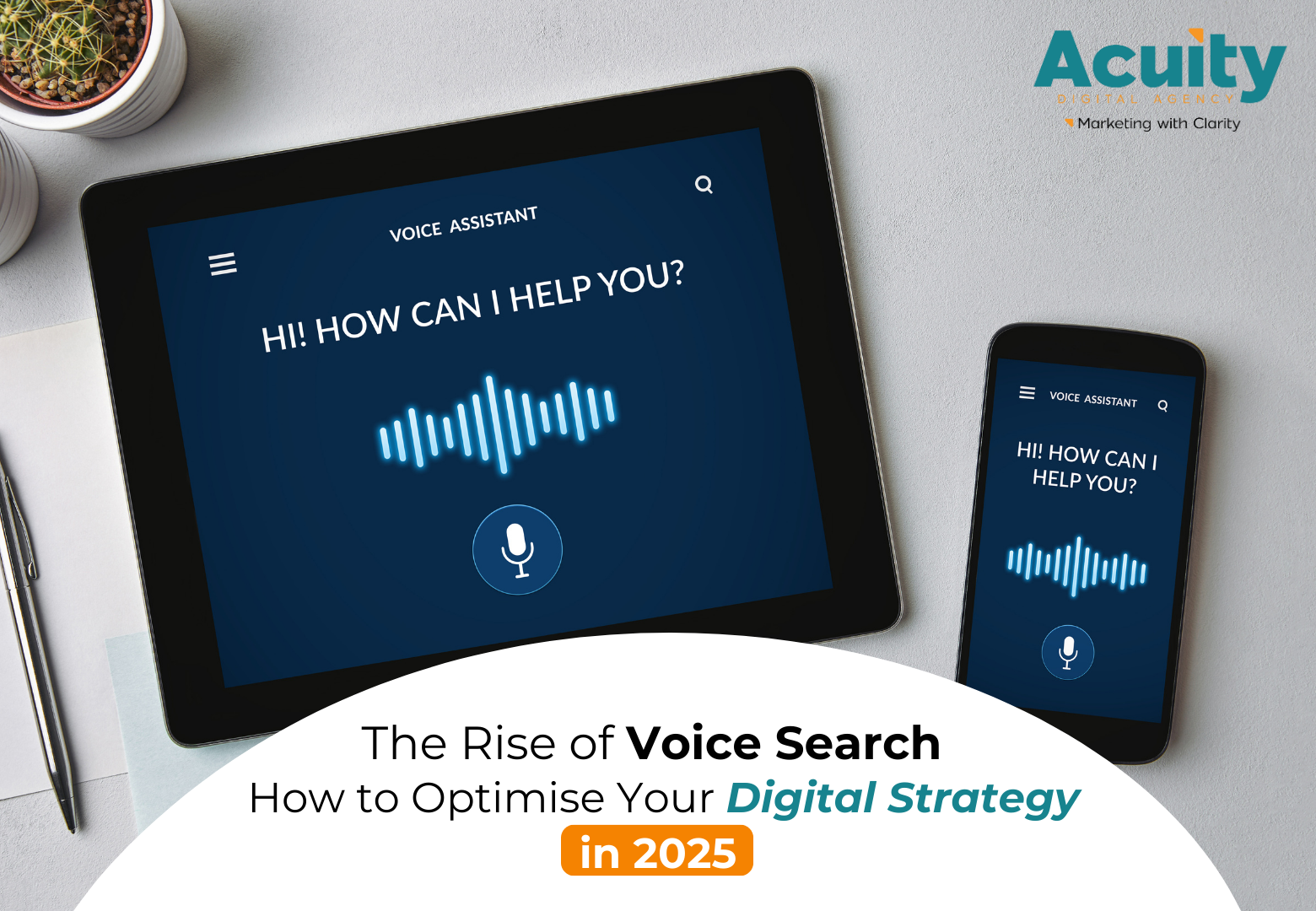
In 2025, voice search is no longer a futuristic notion—it’s ingrained in the everyday behavior of millions of people. As smart speakers, voice assistants on smartphones, and other modern AI devices proliferate, more individuals have begun to speak to their devices, rather than type. This change in user behavior presents new challenges and enormous opportunities for businesses attempting to stay relevant in an online world.
At Acuity Digital Services, we believe that adapting to the evolution of voice search reliance isn’t a choice. If your digital strategy isn’t voice-search ready, your brand may be missing out on a sizable self-qualified audience.
Why is Voice Search Flourishing?
Let’s face it, talking is faster and more convenient than typing. Regardless of whether someone is cooking, driving, or juggling several responsibilities, voice search adds convenience to obtaining those immediate answers. Current trends illustrate that:
- Over 70% of smartphone users conduct a voice search daily.
- “Near me” searches, and conversational queries are steeply increasing.
- Voice assistant services such as Siri, Alexa, and Google Assistant are becoming more refined and accurate, meaning they are even more beneficial than ever before.
All of this means one main thing: your digital content needs to adapt to being conversational and exploit the way people speak, not just how they type.
Key Differences Between Voice and Text Search
Voice search affects not only the technology we use to search the Internet, but also the way people structure their questions. When searching with a text query, a user might type:
Text: “best pizza NYC”
But with a voice search that same user may say:
Voice: “Where is the best pizza place in New York City around me?”
Starting to see the transition? Voice search queries are longer, often more conversational, and very often question-based. If you want to remain competitive with relevant content, and an effective SEO strategy, you need to pay attention to this change in structure and question-based approach.
How to Optimise Your Strategy for Voice Search
Here are five ways to prepare your digital strategy for voice search in 2025:
1. Focus on Natural Language & Long-Tail Keywords
Voice-prompted searches are more conversational, therefore your content must focus on a more natural flowing conversation. If I were to type short keywords like “digital agency,” there are other questions I should include, like “What does a digital agency do?”, or “best digital marketing company for small business.”
Think words that real people use when speaking, especially when they are asking a question!
2. Use Structured Data Markup (Schema)
Search engine companies use structured data markup (schema) to identify content within your website. If a schema is added to pages, SEO and search engines can use that information to show up in rich results or simply read the relevant information to be rendered as an answer to users by a voice assistant search engine.
For example, if you have a local bakery, you could add a schema that provides Google the business hours, address, and contact information.
3. Focus on Local SEO
Commonly many searches for voice search topics will be local based. Asking things like:
- “Where’s the nearest hairdresser?”
- “Which coffee shop is open right now?”
Make sure your Google Business Profile is up to date, check your NAP (Name, Address, Phone) is consistent across the web and make sure to include relevant local keywords in your content.
4. Provide Content that Answers Questions
Voice search is based on getting quick, clear answers. Adding FAQ sections across your pages is a smart option. Structure the question-answer in one clear, concise place to give search engines all the info they need.
Example:
Q: How do I improve my websites SEO in 2025?
A: Mobile speed, voice search optimising, relevant content.
Completing the question-answer format allows search engines to easily pull your content as a featured snippet or spoken answer.
5. Improve Page Speed and Mobile Experience
Most voice searches happen on mobile, so if your website is slow or not designed for mobile, the chances of attracting users (and search engines) are very slim. You need to, obviously, reduce your page load time, have a responsive site, and simple user navigation.
6. Include Conversational Type Content in Blogs and Landing Pages
The days of writing overly robotic, keyword stuffed content is over. In 2025, digital content has to feel human. You need to write as if you are actually responding to a customer’s question in real life. Speak using basic language, include contractions (e.g. “you’re” instead of “you are”), and write in a tone more like a casual conversation.
At Acuity Digital Services, we help brands write content in alignment with how modern users use less formality with their speech and searches. We deal with all things from the tone of voice, to search engine structure.
Conclusion
With more and more users accessing information entirely by voice search, we have to rethink how we respond to questions. It’s not a matter of which website ranks the best for generic short keywords but instead, how are you answering real questions and in real time as naturally as possible.
If you are not voice optimised, it is definitely time to get on this band wagon. You want to future-proof your brand? Let Acuity Digital Services help you navigate the transition through intelligent conversational based SEO and content that speak your customers’ language – literally.