If you want to rank higher on Google in 2026. This is the blog you’re looking for. We break down 14 simple, proven SEO steps to improve your website visibility, bring in more organic traffic, and grow your business, whether you are a beginner or a small business owner.
Getting your website to rank at the top of Google sounds complicated, but it does not have to be. The rules have shifted in 2026. Google now rewards websites that are genuinely helpful, trustworthy, and easy to use. You don’t need a big budget to make it happen.
These easy SEO tips are built on what actually works.
Step 1: Understand What Your Audience Is Actually Searching For
Before writing a single word, think about your reader. What problem are you trying to solve? What question are your readers typing into Google?
You can use free tools like Google Search Console or you can just search “people also ask” on Google and use any free tool, it helps to spot real search queries that your competitors may miss. When you write content that answers a person’s question, Google rewards it.
Step 2: Pick Keywords That You Can Actually Win
Not all keywords are good. A small website can’t compete with a big brand for a broad term like “marketing.” Instead, go after specific, lower competition phrases.
Good keyword targets share these traits:
- Clear and specific meaning
- Moderate search volume
- Low to medium competition
- Directly tied to your product or service
To find tools for it, you can search for “keyword research tool”. Some of the good tools are SE ranking, Semrush, and Ahrefs.
Check traffic, keyword difficulty, and domain authority. And pick any good keyword that fits your brand.
- Traffic: look for traffic that match you desire and the market
- Keyword difficulty: Aim for low difficulty or medium difficulty.
- Domain authority: Domain authority is a third-party score that shows how strong your website is compared to others. Google does not use it as a ranking factor, but it is still a useful way to see where you stand against your competitors.
To check your score, use Small SEO Tools.
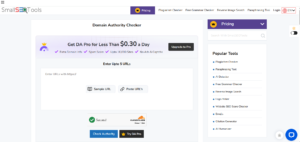
It is free and takes just a few seconds. The higher your score compared to competing sites, the better your chances of outranking them.

Step 3: Rank Higher on Google by Matching Search Intent
This is one of the most overlooked steps. A keyword means nothing if the content does not match what the user actually wants. Someone searching “best running shoes” wants a list, not a history of sneakers.
Always ask yourself: Is this person looking for information, a product, or a comparison? Build your content around that answer.
Step 4: Write Long-Form Content That Goes Deep
Google rewards content that fully covers a topic. If your page only includes surface-level knowledge, it will likely rank low.
You don’t always need a 3000-word post, but for competitive topics, going deeper builds more trust with Google.
Step 5: Optimize Your On-Page SEO Elements
Your title tag, meta description, headings, and URL all matter. Keep your main keyword in the title tag and naturally within the first few lines of your content.
Short checklist for on-page SEO:
- Keyword in the H1 title
- Keyword in the meta description
- Descriptive, clean URL
- At least two supporting subheadings
- Image alt text that describes the image
Step 6: Make Your Content Easy to Read
Most readers do not read every word. They scan. Use short paragraphs, subheadings, and bullet points so your content is easy to digest at a glance.
This also helps Google pull your content into featured snippets and AI Overviews, which is a huge visibility boost in 2026.
Step 7: Build Trust With E-E-A-T
Google’s quality guidelines focus on Experience, Expertise, Authoritativeness, and Trustworthiness. In simple terms: show that a real, knowledgeable person wrote the content.
Add an author bio, link to credible sources, include real examples or personal insights, and keep your information accurate and up to date. These steps apply whether you run a blog or want to know how to improve Google ranking for small business websites.
Step 8: Speed Up Your Website
A slow website loses visitors fast. Compress your images, limit heavy plugins, and use a reliable hosting provider.
Aim for a page load time under 2.5 seconds on mobile. Use Google’s free PageSpeed Insights tool to find what is slowing you down.
Step 9: Make Your Site Work Perfectly on Mobile
Google looks at the mobile version of your site first before anything else. This means if your site is slow, broken, or hard to use on a phone, your rankings will drop, even if your desktop version looks perfect or outstanding.
Most people today browse on their phones, so Google treats mobile as the main version of your site. A bad mobile experience pushes your page down in search results.
The best way to catch problems is to test your site on a real phone regularly. Automated tools can miss things that a real user would notice right away. Make it a habit, not a one-time check.
Step 10: Optimize for AI Overviews and Answer Engines
In 2026, AI tools and Google’s AI Overviews often show answers directly on the search page. Many users get what they need without ever clicking a result. This means if your content is not structured well, you miss out on that visibility completely.
To show up in these AI answers, your content needs to be clear and easy to read. Use simple Q&A sections throughout your page. Start each section with a short, direct answer in one or two sentences, then go deeper below it.
This is not just about Google. AI-powered search platforms like Bing, Perplexity, and others pull answers the same way. Writing clean, structured content helps you get picked up across all of them, not just one.
If you want to learn how to optimize content for AI, here is something special for you.
Step 11: Build Backlinks
Links from other trusted websites tell Google your content is worth ranking. You do not need hundreds of them. A few links from relevant, reputable sites can make a significant difference.
Earn backlinks by writing original research, creating helpful guides, or contributing expert quotes to industry publications.
Step 12: Use Internal Links to Connect Your Content
When you write a new blog post or page, link it to other pages on your site. This is called internal linking and it is one of the simplest things you can do to improve your SEO.
When visitors land on your page, internal links give them a reason to keep exploring. The longer they stay on your site, the better it looks to Google. It also helps Google crawl your site and understand how all your content connects.
One thing most people get wrong is using lazy anchor text like “click here” or “read more.” Instead, use descriptive words that tell the reader exactly what they will find. For example, “learn how to do keyword research” is far better than “click here.”
Step 13: Keep Your Content Fresh
Outdated content signals to Google that your site may not be reliable. Revisit your top pages every few months, update statistics, fix broken links, and refresh the examples.
Fresh content often ranks faster than brand new posts, especially for pages already sitting on page two or three.
Step 14: Track Your Progress With Google Search Console
If you are not tracking your SEO, you are basically guessing. Google Search Console is a free tool that shows you exactly which search terms bring people to your site, which pages are ranking, and which ones are losing clicks over time.
Without this data, you have no idea what is working and what needs fixing. You could be spending time on the wrong pages while your best opportunities sit ignored.
Make it a habit to check Google Search Console at least once a week. Look at what is improving, what is dropping, and use that information to decide what to update next. Websites that grow consistently are the ones that pay attention to their numbers.
Conclusion
How to improve Google ranking for small business websites does not require a large team or expensive tools. Start with strong keyword research, write content that genuinely helps people, build trust through E-E-A-T signals, and keep your site fast and mobile-friendly.
Whether you are a solo blogger or a local business owner, these 14 steps give you a clear path to rank higher on Google in 2026. Consistency matters more than perfection. Pick a few steps, apply them this week, and build from there.
Ready to grow your rankings? Acuity Digital Agency is here to help you every step of the way. Click here to get started today.